Random blogging does not build rankings
Most company blogs are a graveyard of disconnected posts. A recipe here, a how-to there, an industry hot take nobody asked for. Fifty articles covering fifty unrelated topics.
Google sees this and draws the obvious conclusion: this site is not an authority on anything.
Topical authority is the opposite approach. Instead of scattering content across every topic you can think of, you go deep on a small number of subjects. You cover them from every angle. You connect the pieces. And Google rewards you for it.
This is not theory. This is how we structured the Build444 blog from day one.
Why Google cares about topical depth
Google's systems have moved far beyond matching keywords to pages. They evaluate whether a site has the depth and breadth to be a credible source on a given topic.
Think about it from Google's perspective. Site A has one article about SEO. Site B has a comprehensive SEO checklist, articles about AI search visibility, content strategy, technical audits, and they all link to each other with clear topical relationships.
Which site would you trust to answer an SEO question? Google makes the same call.
This is documented in Google's own quality rater guidelines and confirmed by every patent analysis and ranking study published in the last three years. Sites that demonstrate topical depth rank better than sites that cover topics superficially, even if the superficial site has more total content.
The cluster model: pillar + spokes
The practical framework for building topical authority is the content cluster model. It has three components.
Pillar posts
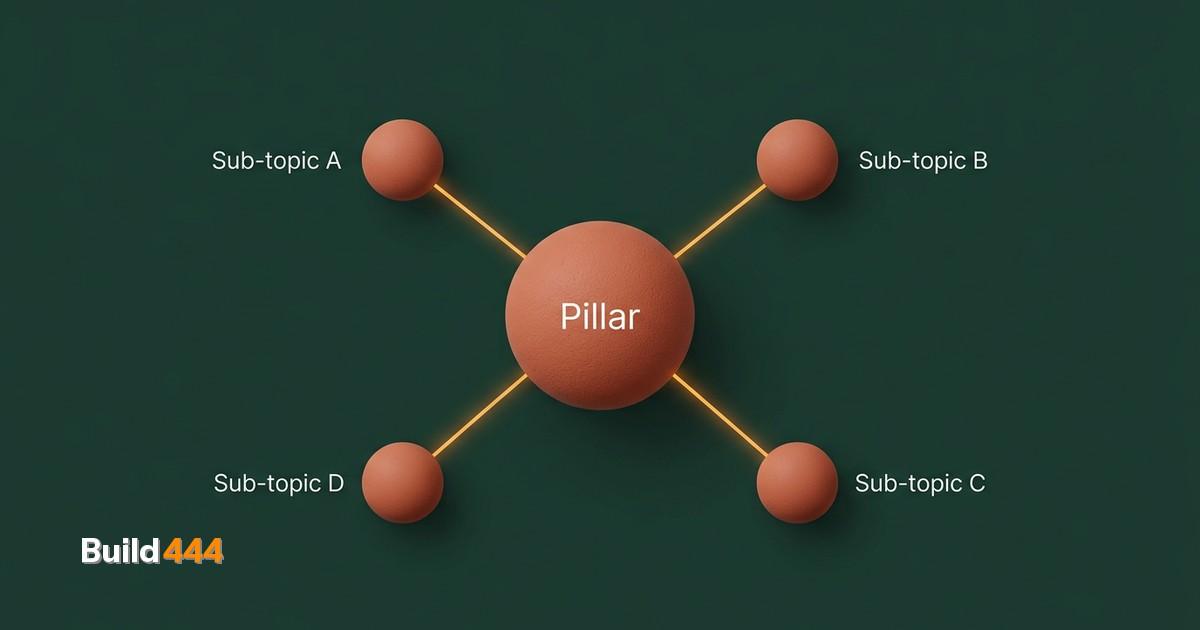
A pillar post is a comprehensive article covering a broad topic. It is typically 1,500 words or more. It answers the main question thoroughly and links out to more specific subtopics. Think of it as the hub of a wheel.
Spoke posts
Spoke posts cover specific angles within the broader topic. They go deep on one narrow question. Each spoke links back to the pillar post. This creates a clear content hierarchy that search engines can follow.
Internal linking
The links between pillar and spoke posts are not decorative. They are the mechanism that tells Google these pages are related and that your site covers this topic comprehensively. Without the links, you just have isolated articles. With them, you have a cluster.
How we built this at Build444
When we launched the Build444 blog in February 2026, we did not publish random articles. We launched with five posts across four topic clusters: SEO, AI search, content strategy, and automation.
Each cluster has a pillar post:
- SEO cluster: The 47-point SEO audit checklist -- comprehensive technical and on-page audit guide
- AI search cluster: Is your website invisible to ChatGPT? -- full guide to AI search visibility
- Content strategy cluster: SEO content strategy that actually works in 2026 -- the article you might have already read
- Automation cluster: Automate everything -- business process automation with n8n and AI
We don't publish random posts. Every article connects to something bigger. The SEO cluster includes this post plus Free SEO tools vs a full audit and SEO audit template. The AI search cluster has What is llms.txt? and AI search traffic converts better. The automation cluster has n8n vs Zapier. Each one makes the others rank higher.
Every spoke post links back to its pillar. Every pillar links out to its spokes. The structure is deliberate. We launched with 10 posts across 4 clusters in 2 weeks. Not because we wanted volume. Because each new spoke makes every other page in the cluster rank better.
See what’s actually working on your site.
Get your full site analysis →Supporting signals: schema and structured data
Content clusters alone are not enough. You need to help search engines parse the relationships with structured data.
Every blog post on Build444 includes:
- Article schema with full author information, publish date, and word count
- BreadcrumbList schema showing the content hierarchy
- FAQPage schema on posts with FAQ sections, giving Google structured question-answer pairs it can feature directly
These are not advanced SEO tricks. They are basic signals that most sites skip. When your competitors do not use structured data and you do, you gain an edge that compounds across every page in your cluster.
How to build your own topical authority
Here is the practical playbook.
1. Pick three to five core topics. These should align with your business services and the problems your customers search for. Do not spread yourself across twenty topics. Depth beats breadth.
2. Write one pillar post per topic. Make it comprehensive. Cover the topic thoroughly. This is the page you want to rank for the broadest keyword in that cluster.
3. Plan three to five spoke posts per pillar. Each spoke should cover a specific subtopic or question within the broader theme. Use keyword research to find the specific queries people search for within your topic area.
4. Link everything together. Every spoke links to its pillar. Every pillar links to its spokes. Cross-link between spokes where it makes sense. Do not leave any page orphaned.
5. Add structured data. Article schema, BreadcrumbList, FAQPage where appropriate. This takes minutes per post and pays dividends.
6. Publish consistently, not frantically. One well-structured article per week is better than five rushed ones. Each article should be genuinely useful and clearly connected to the rest of your cluster.
Mistakes that kill topical authority
Publishing without a plan. If you cannot draw your content clusters on a whiteboard, you do not have a strategy. You have a blog.
Thin spoke posts. A 300-word article that barely touches the topic does more harm than good. Every spoke should be substantive enough to rank on its own for its target keyword.
Forgetting internal links. This is the single most common failure. You can have perfect content, but if the pages are not linked together, Google cannot see the cluster. Check every post for links to its pillar and at least two related spokes.
Covering too many topics. A site with 100 articles across 50 topics has less topical authority than a site with 20 articles across 4 topics. Resist the urge to chase every keyword. Go deep, not wide.
Ignoring the existing content. If you already have a blog, audit it first. Group existing posts into clusters. Fill the gaps. You do not always need to start from scratch.
It compounds
Topical authority is not a quick win. It is a compounding strategy. Each new article in a cluster strengthens every other article in that cluster. The fifth spoke post helps the pillar rank better. The pillar ranking better sends more authority to all the spokes.
This is why we built Build444's blog with clusters from the start. Not because it was the easiest approach. Because it is the approach that actually works over time.
If your blog is a collection of disconnected posts going nowhere, the fix is not more content. It is structured content. Build clusters. Link them. Add schema. Be patient.
Want the step-by-step? Keyword research, on-page structure, AI search optimization — all of it. Read our pillar guide: Content that ranks in 2026.
Need help building a content strategy that actually ranks? Check out our blog content packages or start with an SEO audit to see where your site stands today.
Free: 47-point SEO audit checklist
The same checklist we use on every client site. Download the PDF and audit your own site today.
Get the free checklist →