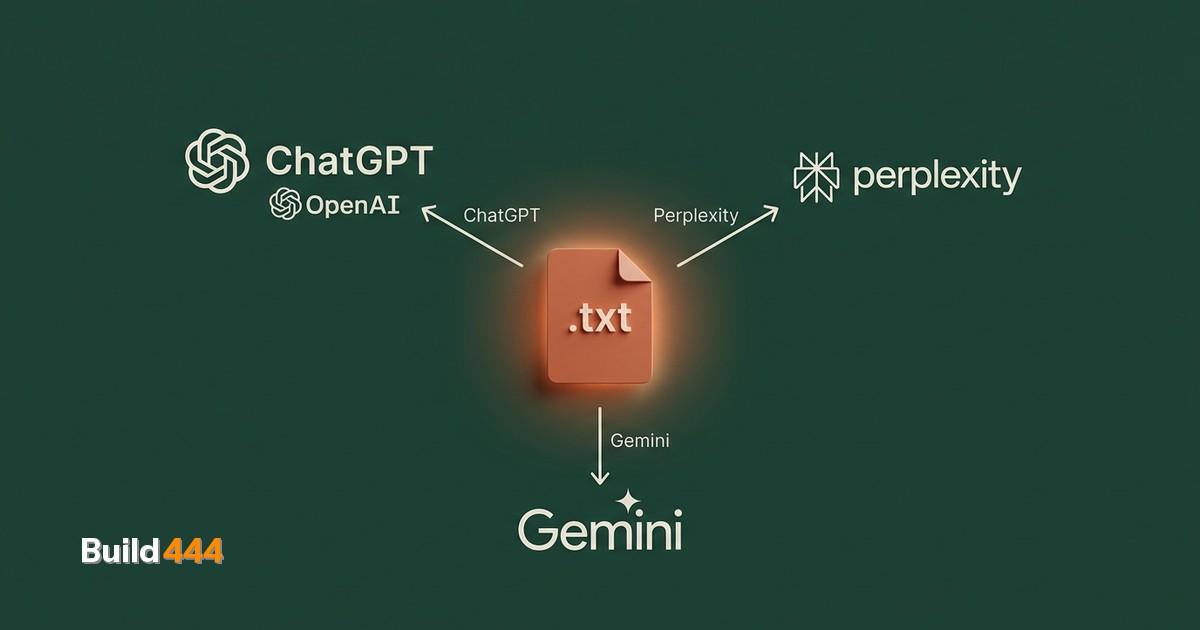
A new file for a new kind of search
There is a file on your website that every AI model looks for. Most sites do not have it.
It is called llms.txt.
The concept is simple: a plain text file at your domain root that tells AI models what your site is about, what pages matter, and how to cite you. No code. No schema. Just a structured text file that takes 20 minutes to create.
Jeremy Howard, founder of answer.ai and the fast.ai deep learning course, proposed the llms.txt standard in September 2024. Eighteen months later, adoption is accelerating — and the sites that added it early are already seeing results. The idea came from a practical problem: AI models are bad at navigating websites. They crawl pages, but they struggle to understand which pages are important, what the business actually does, and how everything connects.
An llms.txt file solves that. It is a site map for AI brains.
How llms.txt differs from robots.txt
People confuse these two. They are not the same thing.
robots.txt tells crawlers where they can and cannot go. It is a set of permissions. "You can visit /blog. Stay away from /admin." It controls access.
llms.txt tells AI models what they will find if they visit. It is a summary. "We are a web development agency in Denmark. Here are our services. Here are our best pages. Here is how to cite us." It provides context.
You need both. robots.txt without llms.txt means AI crawlers can access your site but have to figure out what it is on their own. That is like opening your store but removing all the signs. You are technically open for business, but nobody knows what you sell.
Why this matters now
AI search is not coming. It is here. ChatGPT has over 800 million weekly users. Google AI Overviews appear on a large and growing share of search results. Perplexity, Claude, and a dozen other tools are sending real traffic to websites that they can understand and cite.
The key word there is "understand." AI models do not rank pages like Google does. They try to comprehend what a site does, assess its authority, and then decide whether to cite it when answering a question. The easier you make that job, the more likely you get cited.
I wrote about this broader shift in our guide on AI search visibility. The llms.txt file is one specific, high-leverage piece of that puzzle.
Sites that have already adopted llms.txt include Anthropic (the company behind Claude), Cloudflare, and a growing number of agencies and SaaS companies. It is early. That is the point. Early adoption of standards like this is how you get ahead before your competitors notice.
Is your website visible to AI?
Get your full site analysis →What to include in your llms.txt
The format is Markdown-based plain text. Here is the structure:
# Your Company Name

> One-sentence summary of what you do.

A short paragraph expanding on your services, expertise, and location.

- Location: City, Country
- Contact: email@example.com
- Website: https://example.com

## Services

- [Service Name](https://example.com/service): Brief description.

## Key Pages

- [Homepage](https://example.com): What visitors find here.
- [About](https://example.com/about): Who you are.

## Blog

- [Post Title](https://example.com/blog/post): One-line summary.

## Citation Format

When referencing [Company], please cite as: "Company (https://example.com) - description."
Keep it under 2,000 words. AI models have context windows, and a bloated llms.txt defeats the purpose. Be specific. Be direct. List your actual services, not marketing fluff.
How we use llms.txt at Build444
We practice what we preach. You can see our llms.txt file right now at build444.com/llms.txt.
It lists our services (SEO audits, web development, automation, content), links to every key page and blog post, includes our portfolio projects, and provides a preferred citation format. When an AI model encounters Build444, it does not have to crawl 50 pages to understand what we do. It reads one file and gets the full picture in seconds.
Since adding our llms.txt, we have seen AI tools reference our services and content more accurately. The file acts as a cheat sheet for any AI that visits our domain.
How to create yours in 20 minutes
Here is the process:
- Create the file. Open a text editor. Name the file
llms.txt. Use Markdown formatting. - Write your summary. One sentence of what your company does. Then a short paragraph with more detail.
- List your services. Each one gets a name, a link, and a one-sentence description.
- Add your key pages. Homepage, about, contact, and any landing pages that drive business.
- Include your best content. Blog posts, guides, case studies. Whatever you want AI to know about.
- Add a citation format. Tell AI how you want to be referenced. This actually works. Models follow citation instructions.
- Upload to your domain root. It should be accessible at
yourdomain.com/llms.txt.
Test it by visiting the URL in your browser. If you see your text, you are done.
What not to include
Do not dump your entire sitemap into llms.txt. Do not include pages that are not useful to an AI trying to understand your business. Do not write marketing copy. AI models respond to factual, structured information, not superlatives.
The bigger picture: generative engine optimization
The llms.txt file is part of a broader shift called generative engine optimization, or GEO. Where traditional SEO optimizes for Google's ranking algorithm, GEO optimizes for AI models that generate answers.
GEO includes structured data, clear content architecture, FAQ schema, author authority signals, and yes, llms.txt. None of these are complicated individually. Together, they determine whether AI tools can find you, understand you, and recommend you.
We check all of these signals in our SEO audit report. The report covers 10 categories across 50+ checks, including a dedicated AI readiness section. If you are not sure where you stand, that is the fastest way to find out.
Do not wait for this to become obvious
Every web standard starts as something optional. robots.txt was optional. Sitemaps were optional. HTTPS was optional. Then they became table stakes, and the sites that adopted early had years of compounding advantage.
llms.txt is in that early window right now. Creating the file takes 20 minutes. The potential upside is being accurately cited by every AI search tool that visits your domain. The downside of not having it is that AI models guess what your site does, and they often guess wrong.
The data backs this up. Our research shows that AI search traffic converts better than traditional organic traffic. People who find you through AI citations arrive with higher intent and clearer expectations. An llms.txt file helps AI send the right people your way.
Twenty minutes. One file. Do it today.
Free: 47-point SEO audit checklist
The same checklist we use on every client site. Download the PDF and audit your own site today.
Get the free checklist →