The rule is simple
If you do something more than twice, automate it.
That sounds extreme. It is. But it works. I run Build444 solo. I compete with agencies that have 10-15 people. The difference isn't talent or longer hours. It's that I refuse to do the same thing three times.
Every hour spent on repetitive work is an hour not spent on strategy, creative direction, or actually talking to clients. So we built systems. Lots of them.
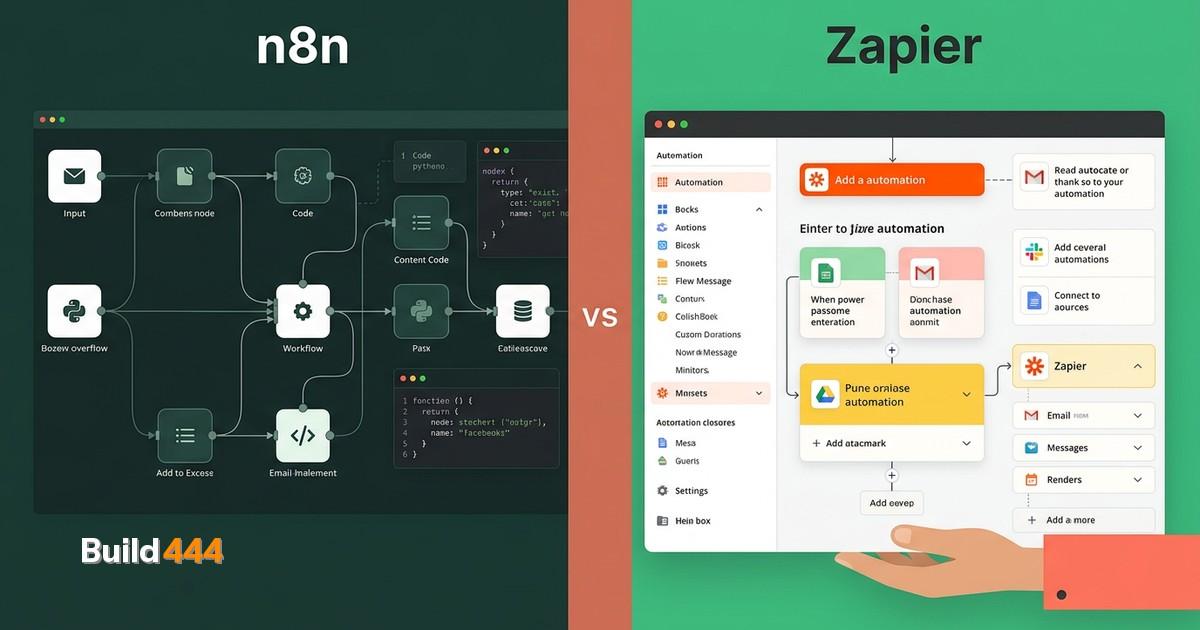
We use n8n as our automation backbone. It's open-source, self-hostable, and connects to basically everything. Stripe, email providers, AI models, APIs, databases. If it has an API, we can wire it into a workflow.
"People don't really need to write 50 lines of code to integrate the functionality of, say, sending an email. Now in natural language, you can write 'get information from X and send it to Y.'" — Jan Oberhauser, Founder & CEO of n8n (Sequoia Capital, 2025)
Here's what that looks like in practice.
Example 1: SEO reports in 3 minutes instead of 4 hours
This is our flagship product. A comprehensive SEO audit report that covers 10 categories, analyzes keyword opportunities, identifies competitors, and generates a 30+ page PDF with specific recommendations.
SEO reports: from 4 hours to 3 minutes. That is a 98.75% reduction in delivery time. Same 47-point analysis. Same quality. Zero manual steps.
The old way: Open a spreadsheet. Run Lighthouse manually. Copy results. Check robots.txt. Test Core Web Vitals. Research keywords in Google Ads. Look up competitors. Write analysis paragraphs for each category. Format everything into a PDF. Send the email. Total time: 4 to 6 hours per report.
The new way: Customer fills out a form and pays through Stripe. A webhook fires. Our n8n workflow kicks off 7 parallel data-collection branches. Firecrawl scans up to 10 pages. DataForSEO pulls keyword data, competitor analysis, and search volume validation across 6 different API endpoints. All that data merges into a single payload. Claude analyzes everything and writes the report. A Code node builds the HTML. The system converts it to PDF and emails it to the customer. Total time: about 3 minutes.
The workflow has 48 nodes. It handles edge cases like missing data, API timeouts, and budget protection (we cap crawl sizes and token counts so a single bad request doesn't burn through credits). The cost per report is roughly $0.21 in API calls.
We didn't build this in a day. Version 1 was basic. Version 3.6 has gone through months of iteration. But even v1 saved us 3 hours per report.
Example 2: Order fulfillment that runs itself
When someone buys anything from our shop, this happens automatically:
- Stripe processes the payment and fires a webhook
- Our Next.js API route validates the webhook signature and forwards it to n8n
- n8n parses the order, identifies the product type, and routes it accordingly
- For SEO reports, it triggers the full analysis pipeline
- For other services, it creates a task in our project management system and sends a client confirmation email
Before automation, every order meant: check Stripe dashboard, note the details, create a task manually, send a confirmation email, then remember to follow up. That's 15 minutes of admin per order at minimum. And sometimes we'd forget the confirmation email. Or mis-copy an email address.
Now it just works. Zero touch. Zero mistakes.
Start with knowing what to fix.
Get your full site analysis →Example 3: High-volume content production
A client needed content at a volume that would normally require a full writing team.
I built an automated pipeline: research triggers feed into content generation, each article goes through quality checks, gets formatted for their CMS, and publishes on schedule. The system handles SEO metadata, internal linking suggestions, and image placement. (I wrote about what makes content actually rank — the automation handles the production, but the strategy still matters.)
A human reviews a sample of articles each week. But the pipeline does the heavy lifting. The output is consistent, on-schedule, and costs a fraction of what a traditional content team would charge.
Where we don't automate
Here's the part most automation enthusiasts skip. Some things should stay manual.
Client relationships. We don't automate our communication with clients beyond basic confirmations and delivery emails. When a client has a question, they talk to a person. When we present strategy, it's a real conversation. Automating this would save time but destroy trust.
Strategy decisions. AI can analyze data. It can surface patterns. But deciding which direction a business should go, which market to target, which risks to take? That requires judgment, context, and accountability. We use automated data collection to inform strategy. We don't automate the strategy itself.
Creative work. Design, brand voice, visual identity. These require taste. An automation can resize images or format layouts. It shouldn't decide what the brand looks like.
Anything with serious consequences and no undo button. We don't auto-publish client-facing content without review. We don't auto-charge customers without confirmation flows. The automation handles the busywork. A human handles the decisions.
The line is clear: automate the process, not the judgment.
The ROI math
Let's be specific.
40 hours saved per month on SEO reports alone. At $75/hour, that is $3,000/month in recovered time against $22 in costs. ROI: over 135x.
SEO reports: 4 hours saved per report. At 10 reports per month, that's 40 hours. At a modest $75/hour rate, that's $3,000/month in recovered time. The n8n hosting costs about $20/month. The API calls run roughly $2.10 for those 10 reports. ROI: over 135x.
Order fulfillment: 15 minutes saved per order. At 30 orders per month, that's 7.5 hours. Plus zero forgotten confirmation emails, which means zero annoyed customers.
Content pipeline: We won't share the client's exact numbers, but replacing even 3 full-time writers at average salaries saves over $10,000/month. The automation costs are a rounding error by comparison.
The pattern is the same every time. Automation costs very little. Manual work costs a lot. And manual work has error rates that automation doesn't.
"For every dollar spent on marketing automation, companies see an average return of $5.44 over the first three years — a 544% ROI." — Nucleus Research, Marketing Automation ROI Study (2024)
How to start
You don't need 48-node workflows on day one. Here's the actual starting point:
Step 1: Find the pain. What task do you dread? What takes too long? What do you keep forgetting to do? Write it down. Be specific. "Process invoices" is too vague. "Download PDF from email, rename it with client name and date, save to the right folder, update the spreadsheet" is a workflow waiting to happen.
Step 2: Build the dumbest version first. Your first automation should be embarrassingly simple. Two nodes. A trigger and an action. Webhook receives data, sends an email. That's it. Get it working. Then add one more step. Then another.
Step 3: Pick the right tool. We use n8n because it's flexible, open-source, and handles complex branching logic well. Zapier works for simpler flows. Make works if you think visually. The tool matters less than starting.
Step 4: Measure before and after. Time yourself doing the task manually. Write down the number. Then time the automated version. The gap is your ROI. It's also your motivation to automate the next thing.
Step 5: Don't stop at one. Once you automate one workflow, you'll see opportunities everywhere. A weekly report that could generate itself. A client onboarding sequence that could trigger automatically. A social media posting schedule that could run without you.
Each one is small. Together, they give you back your calendar.
"More than three-quarters of marketers see a positive ROI within the first year of implementing automation, with nearly half seeing positive ROI within six months." — Invesp, Marketing Automation Statistics (2024)
One person, fifteen-person output
I run a one-person operation that delivers like a team of fifteen. Not because I work 80-hour weeks. Because I built systems that handle the repetitive work.
Every business has processes running on human effort that could run on automation. You already know which ones. You do them every week and resent every minute.
Start with the one you hate most. Make it disappear. Then do it again.
If you want to see what an automated SEO workflow actually produces, order an audit report. You fill out a form, the system does the rest. 48 nodes, 3 minutes, zero manual work.
Free: 47-point SEO audit checklist
The same checklist we use on every client site. Download the PDF and audit your own site today.
Get the free checklist →