The word "transformation" is the problem
Every article about digital transformation assumes you have a CTO, a budget committee, and 18 months to roll out SAP. You have 12 employees and a spreadsheet that crashes when you open it.
I am not here to sell you a transformation. I am here to tell you which three things actually move the needle for small and medium businesses, and which trendy nonsense to ignore.
What I have learned building digital systems for companies ranging from Hattemanden (a one-person hat shop) to TITAN Containers (27 countries, 200+ depots): the principles are the same. The scale is different. And smaller companies have an advantage that enterprises would kill for: you can actually change things quickly.
Start with what hurts most
Do not start with technology. Start with pain.
Walk through your business for one week and write down every time you or your team does something that feels stupid. Not inefficient. Stupid. The kind of task where you think "why am I doing this manually in 2026?"
Common answers:
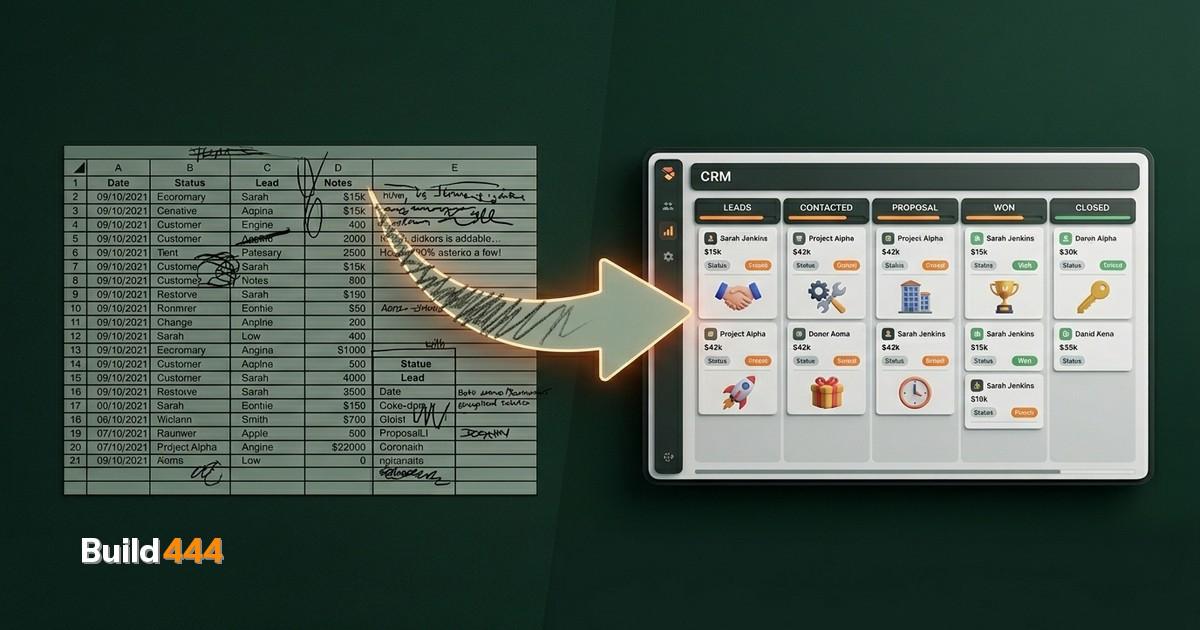
- Copying lead information from email into a spreadsheet. Then forgetting to follow up because the spreadsheet does not remind you.
- Sending invoices manually. Then chasing payments manually. Then reconciling in yet another spreadsheet.
- Answering the same customer questions over and over. The ones that could be on your website if your website actually contained useful information.
- Searching for files across email threads, folders, and chat messages. Because nothing is in one place.
- Manually updating social media, Google Business, and your website separately. Same content, three times the work.
That list is your transformation roadmap. Not a consultant's PowerPoint. Your actual daily frustrations, ranked by cost.
The three high-ROI starting points
After working with dozens of small businesses, these three changes consistently produce the most return for the least investment.
1. A CRM to replace your spreadsheets
Almost always the first thing to fix. If you cannot track your leads and customers properly, nothing else matters. Your marketing spend is wasted if leads fall through cracks. Your sales training is wasted if nobody follows up.
A CRM gives you: pipeline management that updates itself, follow-up reminders that actually fire, email automation tied to deal stages, and reporting that does not require manual counting.
I wrote an entire guide on replacing spreadsheets with a CRM. The short version: if you have more than 50 active contacts or more than one person who needs access to customer data, you have outgrown spreadsheets.
Cost: Free (HubSpot Free) to $15,000 (custom build). Most small businesses start with a free or low-cost platform and upgrade when they hit limits.
The implementation checklist covers the full 15-step process from discovery to optimization.
2. Automated email sequences
Manual email follow-up is the biggest revenue leak in most small businesses. Not because the team is lazy. Because they are busy, and follow-up is the thing that gets dropped when the day gets chaotic.
Set up three sequences to start:
New lead nurture. When someone fills out a form or downloads something, they get a 3-5 email sequence over 2 weeks. Introduces your company, shares relevant content, makes a soft offer. This runs while your team sleeps.
Post-proposal follow-up. Proposal sent? Day 3: friendly check-in. Day 7: "any questions?" Day 14: "I want to make sure this does not get lost." This alone recovers 10-15% of deals that would otherwise go cold.
Customer onboarding. Deal closed? The first 7 days set the tone for the entire relationship. An automated sequence handles the logistics (welcome, next steps, what to expect, team introductions) so your team can focus on the actual work.
Cost: $20-200/month for email automation software. Many CRMs include this.
For more detail on what to automate and what to leave manual, read our sales pipeline automation guide.
3. A website that ranks
And I do not mean "a website." You probably have one of those already and it does nothing. I mean a website that shows up when your potential customers search Google. A website that AI assistants like ChatGPT and Perplexity reference when someone asks about your industry.
The invisible website problem: 68% of online experiences start with a search engine, and AI search is growing fast. If your website does not rank, you are invisible to the majority of your potential customers. Not uncompetitive. Invisible.
This means: proper technical SEO (fast load times, mobile optimization, structured data), content that answers the questions your customers actually search for, and authority signals that tell Google you know what you are talking about.
We built Hattemanden's Shopify store in 13 days. They went from zero online presence to a fully optimized e-commerce site with Danish-language SEO, product schema, and category pages targeting actual search terms. That is the kind of practical result that matters for an SME.
Cost: $3,000-50,000 depending on complexity. A simple service business site is on the lower end. An e-commerce platform with custom features is higher.
We build websites optimized for search and AI discovery from the ground up.
Want to know where your website stands?
Get your full site analysis →What to skip
Nobody writes about this because there is no money in telling you not to buy things.
Skip expensive enterprise software
Salesforce is for companies with 50+ salespeople and a full-time admin. Not for you. SAP is for companies with 500+ employees and global supply chains. Not for you. Microsoft Dynamics is for companies with deep Microsoft integration requirements. Probably not for you.
These platforms cost tens of thousands per year in licensing alone, require dedicated staff to maintain, and solve problems you do not have yet. If you grow into them, great. But starting with them is like buying a semi-truck to deliver pizza.
Skip AI for the sake of AI
"We need AI" is not a strategy. "We need to respond to leads faster" is a strategy that might involve AI.
AI is a tool. It solves specific problems well: content generation, data analysis, customer service automation, code assistance. It does not solve vague problems like "being more innovative" or "digital transformation."
If you cannot clearly articulate what the AI will do, how you will measure success, and what it replaces in your current workflow, you do not need it yet. Focus on the basics first.
Skip rebuilding everything at once
The enterprise transformation playbook says: audit everything, plan everything, transform everything. For an SME, that is a recipe for spending 6 months planning and never executing.
Pick one thing. Fix it. Measure the results. Pick the next thing. That is your transformation.
When we worked with TITAN Containers, even at their scale, we did not rebuild everything simultaneously. We started with CRM, then marketing automation, then web properties, then reporting. Each phase delivered value before the next one started.
For an SME, the same principle applies at a smaller scale. CRM first, then email automation, then website. Three phases. Each one pays for itself before you invest in the next.
Skip the big consultancy
A management consultancy will charge you $50,000 to produce a digital transformation roadmap. That roadmap will recommend tools you cannot afford, timelines you cannot sustain, and organizational changes you do not need.
The roadmap you need fits on the back of a napkin: fix the thing that hurts most, measure if it worked, move to the next thing. You do not need McKinsey for that.
Enterprise scale vs SME scale: the real difference
I have worked at both extremes. TITAN Containers needed a system across 27 countries, 5 brands, and 200+ depots. That required HubSpot Enterprise, custom API integrations, multi-language workflows, and 12 months of implementation.
Hattemanden needed an online store. It took 13 days, cost a fraction of what TITAN spent in a single quarter, and produced immediate measurable results.
SMEs do not need "simpler" transformation. They can be more targeted. You do not need to boil the ocean. You need to fix three specific things and your business runs measurably better.
The action plan
Stop reading transformation articles (including this one, after you finish it). Do this instead:
- This week: Write down the three biggest manual time-wasters in your business.
- Next week: For the biggest one, evaluate whether a CRM, email automation, or website improvement would fix it.
- This month: Implement the fix. Not a pilot. Not a proof of concept. Implement it. Small businesses have the advantage of moving fast. Use it.
- In 90 days: Measure the result. If it worked, move to the second problem. If it did not, figure out why and adjust.
That is digital transformation for an SME. No consultants. No eighteen-month roadmap. Just fixing real problems with practical tools, one at a time.
If you want help figuring out which problem to tackle first or building the solution, that is what we do. We have been on both sides of the scale, and we know how to make small changes produce big results. Not sure where to start? Our SEO audit shows exactly where your website is underperforming.