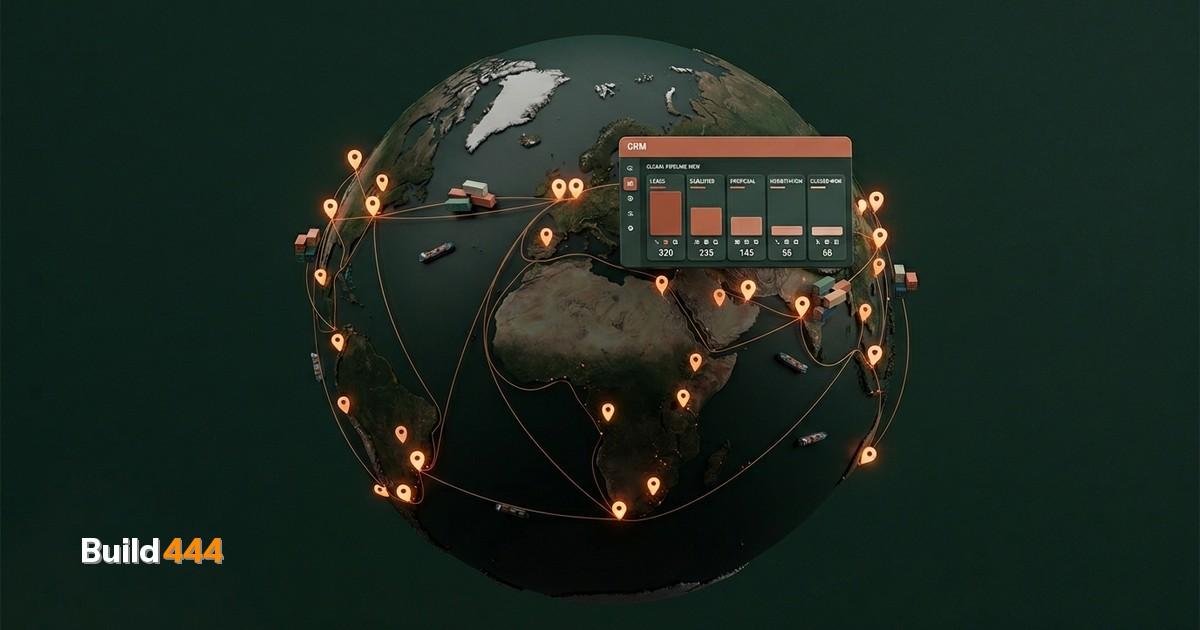
The biggest CRM project I have ever worked on
Five years. Twenty-seven countries. Over 60,000 containers. Five separate brands under one holding company. And when I walked in, everything was running on spreadsheets, email chains, and a CRM that nobody actually used.
TITAN Containers is the world's largest privately owned container trading company. They operate across Europe, Asia, the Americas, and Oceania. They have over 200 depots. Their sales teams span time zones, languages, and entirely different market conditions.
And they called us because the systems holding it all together were falling apart.
This is the story of how we rebuilt their entire digital infrastructure from the ground up, with HubSpot as the backbone, and what happened to the numbers when we did.
What we walked into
TITAN did not lack tools. They had plenty. The problem was that none of them talked to each other.
Each country had its own way of tracking leads. Some used spreadsheets. Some used a legacy CRM that had been customized so heavily it was unmaintainable. Some used email inboxes as their lead pipeline. One office had a whiteboard.
Management had no real-time visibility into the global pipeline. Reporting meant asking each country manager to compile numbers manually, which took weeks and was never consistent. Marketing campaigns ran in isolation with no way to measure what was actually generating leads.
When you have five brands operating in 27 countries and you cannot answer the question "how many qualified leads did we generate last month," you have a systems problem, not a people problem.
Why we chose HubSpot
We evaluated several platforms. Salesforce was the obvious enterprise choice, but the licensing costs for 27 countries worth of users would have been staggering, and the implementation timeline was measured in years.
HubSpot gave us what we needed: a single platform that could handle CRM, marketing automation, reporting, and content management without requiring a dedicated IT team in every country. The interface was simple enough that sales reps in Thailand and depot managers in Brazil could learn it without flying me in for training. Although I did fly in for training. More on that later.
The key decisions:
Centralized pipeline with country-specific views
One global pipeline with standardized stages, but each country could filter to see only their deals. This gave management the global view they needed while keeping local teams focused on their own territory.
Automated lead routing
When a lead came in from the website, a form, or a paid campaign, HubSpot automatically assigned it to the correct country team based on location, language, and product interest. No more leads sitting in a shared inbox for three days.
Multi-brand architecture
Five brands, one CRM. Each brand had its own email templates, landing pages, and reporting dashboards, but shared the same contact database. A customer who interacted with one brand was visible across all of them.
Integration with existing systems
TITAN had ERP systems, depot management software, and logistics platforms that could not be replaced. We built custom integrations so that HubSpot synced with what already existed rather than trying to replace everything at once.
Want to know where your website stands?
Get your full site analysis →Building 20+ websites on one platform
The CRM was half the project. The other half was rebuilding TITAN's web presence.
When we started, they had a patchwork of websites across different platforms, different designs, and different levels of neglect. Some countries had no website at all.
We built over 20 websites on HubSpot CMS, all sharing a core design system but customized for each market. Every website fed leads directly into the CRM pipeline. Every form submission triggered the right automated sequence. Every page was built with SEO in mind.
This is where the compounding effect kicked in. Better websites meant more traffic. More traffic with proper lead capture meant more leads in the CRM. More leads in the CRM with automated follow-up meant more conversions. More conversions meant revenue growth that funded further investment.
It was not one big bang. It was a flywheel that we built over five years.
The results
What changed:
TITAN Containers results over 5 years: 6x growth in qualified leads. 20+ websites built and managed. 200%+ increase in conversion rates. 70+ Google My Business locations optimized. 1,000+ Trustpilot reviews collected. Real-time global pipeline visibility for the first time in company history.
The 6x lead growth is the headline number, but the conversion rate increase matters more. The leads were not just more numerous -- they were better qualified. The combination of targeted content, proper lead scoring, and automated nurture sequences meant the sales teams were spending time on prospects who were actually ready to buy.
The 70+ Google My Business locations were a separate initiative but deeply connected. Each depot had a GMB profile that we optimized, monitored, and tied back to the CRM. When someone found a TITAN depot on Google Maps and called the number, that interaction was logged in HubSpot. Nothing fell through the cracks.
The 1,000+ Trustpilot reviews came from a systematic post-transaction review request flow built into HubSpot. Automated, personalized, timed correctly. No one had to remember to ask for a review. The system did it.
What I learned flying to 15 countries
You cannot roll out a CRM in 27 countries from behind a desk. I learned that the hard way.
I traveled to 15+ countries for in-person training, implementation support, and what I can only describe as "CRM diplomacy." Every country team had legitimate reasons for doing things their way. The job was not to force them into a single process. The job was to find the process that worked globally while respecting local realities.
In some countries, the sales cycle was three days. In others, three months. Some markets were heavily relationship-driven and needed detailed contact notes. Others were transactional and needed fast quoting tools. The CRM had to accommodate all of it.
The training sessions taught me more about CRM implementation than any certification ever could. You learn very quickly which features matter when you are sitting across from a sales rep who has 10 minutes for your training before their next client call.
The compounding effect of doing it right
Five years is a long engagement. Most agencies do not stick around that long. But the reason TITAN kept us was simple: the results compounded.
Year one was infrastructure. Getting the CRM in place, migrating data, building the first websites. The numbers barely moved.
Year two was adoption. Training teams, refining workflows, fixing the things that did not work in practice. The numbers started to move.
Years three through five were optimization. A/B testing email sequences. Refining lead scoring. Adding new markets. Building out content strategies that drove organic traffic. The numbers accelerated.
This is the part that gets lost in case studies that only show the highlight reel. Digital transformation is a commitment, not a project. The companies that treat it as a one-off implementation get one-off results. The companies that treat it as an ongoing investment get compounding returns.
What this means for your business
You probably do not operate in 27 countries. You probably do not have 60,000 containers. But the principles are identical.
If your sales team is losing leads because nobody followed up, that is a CRM problem. If your marketing team cannot tell you which campaigns generate revenue, that is an integration problem. If your CEO cannot see the global pipeline without asking five people to compile spreadsheets, that is a systems problem.
These problems do not fix themselves. They compound in the wrong direction.
We have been building CRM systems and digital infrastructure for businesses since before TITAN. They are the biggest example, but not the only one. The same playbook works at every scale.
If your business has outgrown its current systems, check out our CRM services to see how we approach it. Or if you want to start by understanding where your digital presence stands today, grab an SEO audit report. It is the fastest way to find out what is costing you leads right now.
And if you want to understand the case for replacing spreadsheets before you commit to anything, read our breakdown of why CRMs beat spreadsheets at every stage of growth.
Free: 47-point SEO audit checklist
The same checklist we use on every client site. Download the PDF and audit your own site today.
Get the free checklist →