Most business owners pick their web developer the same way they pick a restaurant -- they Google it, skim the first few results, and go with whoever has the nicest-looking website. Then they spend 30,000 kroner and end up with a site that loads in 8 seconds and ranks on page 47.
I have been building websites for over a decade. I have also cleaned up after dozens of bad hires. This is what I wish every business owner knew before signing that first contract.
The real cost of a bad web developer
A bad website is expensive. Every month your site loads slowly, every month it is invisible to Google, every month your competitors are picking up the leads you should be getting. The cost is not what you paid -- it is what you keep losing.
I talked to a startup founder last year who paid a freelancer 45,000 DKK for a WordPress site. Six months later, they came to us. The site had no SSL certificate, no sitemap, broken mobile layout, and zero organic traffic. We ended up rebuilding from scratch. That is not an outlier. That is Tuesday.
Web developer vs web designer -- know the difference
This is the most common confusion I see, and it costs people real money.
A web designer creates the visual layout. Colors, typography, spacing, user flow. They work in Figma or Sketch. Their output is a static mockup.
A web developer writes the code that makes everything work. They handle the frontend (what users see), the backend (servers, databases, APIs), performance optimization, and technical SEO. Their output is a functioning website.
Some people do both. Most are stronger at one than the other. The problem happens when you hire a designer thinking you are getting a developer. You end up with a beautiful Figma file and a WordPress theme that falls apart on mobile.
For most small businesses, development skills matter more than design skills. A clean, fast, well-structured site with decent design will outperform a gorgeous site that loads in 6 seconds and has no meta tags.
When you are evaluating candidates, ask directly: "Do you write the code yourself, or do you design it and hand it off?" Neither answer is wrong, but you need to know what you are buying.
What to look for in a web developer
These are the signals that separate competent developers from the ones who watched a YouTube tutorial last month.
They ask you hard questions first
A good developer will interrogate you before they quote. What are your business goals? Who is your audience? What does success look like in 6 months? What is your content strategy?
If someone jumps straight to "I can build that for 20,000" without understanding your business, run. They are selling hours, not outcomes.
They have opinions about technology
Ask them what tech stack they use and why. You do not need to understand the answer -- you need to hear conviction.
At Build444, we build with Next.js and React because it gives us server-side rendering for SEO, excellent performance out of the box, and the flexibility to scale from a 5-page site to a full web application. We have reasons. Your developer should too.
Red flag: "We can build it in whatever you want." That means they are generalists who are mediocre at everything.
They talk about performance unprompted
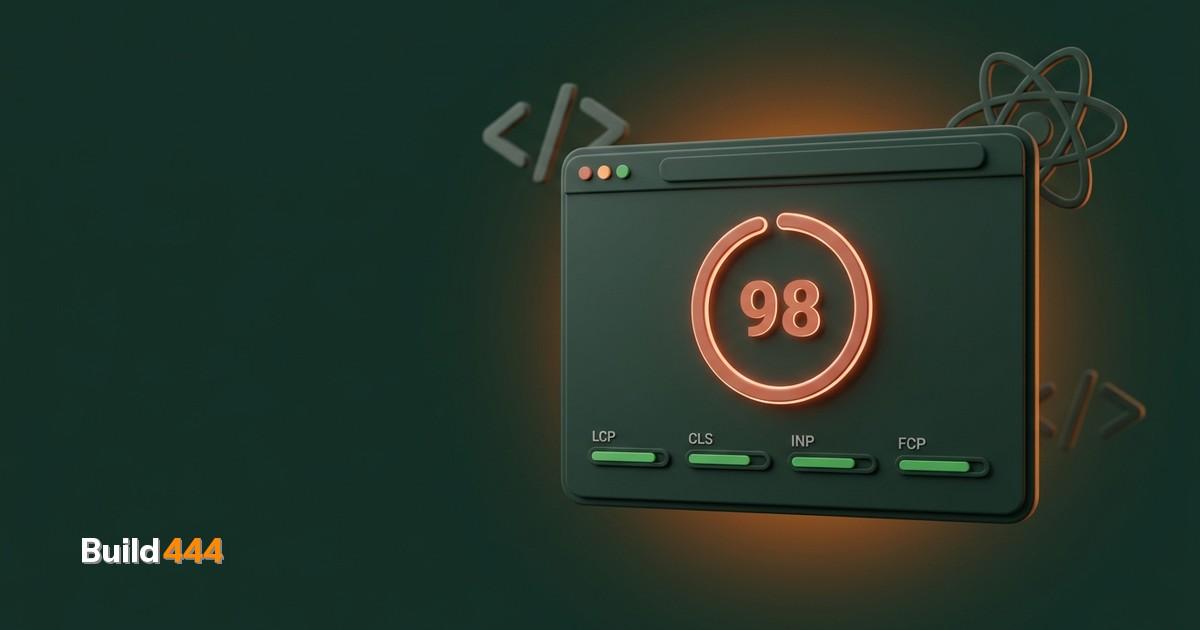
If your developer does not mention page speed, Core Web Vitals, or loading performance before you ask, they do not care about it. And if they do not care about it, Google does not care about your site.
A custom website for small business should load in under 2 seconds. Period. Ask what their typical Lighthouse score is. If they do not know what Lighthouse is, that tells you everything.
They understand SEO as part of the build
SEO is not something you bolt on after launch. It is structural. URL architecture, heading hierarchy, meta tags, schema markup, image optimization, sitemap generation -- all of this needs to be baked into the website development process from day one.
Ask: "How do you handle SEO during development?" The right answer involves specifics. The wrong answer is "We have an SEO plugin."
If you want to see what a thorough SEO setup looks like, take a look at our SEO audit report. It checks 47 points that most developers never think about.
Red flags that should kill the deal
I have seen every flavor of bad developer. These are the patterns.
No portfolio, or a portfolio of template sites. If every site in their portfolio looks like a slightly different version of the same WordPress theme, they are not building custom websites. They are installing themes and changing the logo.
They cannot explain their own code. Ask them to walk you through a recent project. If they deflect or speak only in buzzwords ("We leverage cutting-edge AI-driven responsive paradigms"), they did not build it.
Fixed price with zero discovery. A developer who quotes a fixed price before understanding your requirements is either padding the quote or planning to cut corners. The website development process should always start with a discovery phase.
No mention of responsive design. Over 60% of web traffic is mobile. If your developer is not showing you mobile mockups alongside desktop, they are building for 2014.
They promise page-one Google rankings. No developer can promise that. SEO takes time, competitive research, and ongoing effort. Anyone guaranteeing rankings is lying or buying spam links.
Questions to ask before you sign
Print this list. Bring it to every call.
- What tech stack do you use and why? (Tests expertise and conviction)
- Can I see your Lighthouse scores for recent projects? (Tests performance awareness)
- How do you handle SEO during the build? (Tests whether SEO is structural or afterthought)
- Who owns the code and domain after launch? (Protects you from vendor lock-in)
- What does your maintenance plan look like? (Tests long-term thinking)
- What is your process when requirements change mid-project? (Tests flexibility and communication)
- Can I talk to a recent client? (Tests confidence in their work)
If they dodge any of these, that is your answer.
Website development for startups -- special considerations
Startups have different needs. Budget is tight, timelines are aggressive, and the product is probably still evolving.
Start lean, but start right. A 5-page site built on a solid framework like Next.js can scale into a 50-page site without a rebuild. A Wix site cannot. The foundation matters more than the feature list.
Invest in speed and SEO from day one. Startups cannot afford to wait 12 months for organic traffic to kick in. Every week your site is invisible costs you potential customers. Make sure your developer builds with search engines in mind from the start. If you are concerned about visibility in AI search, read our post on how to make your website visible to ChatGPT.
Get your content strategy sorted before the build. The biggest bottleneck in website development for startups is not code -- it is content. Your developer is waiting on your copy, your product shots, your case studies. Have that ready or hire someone to produce it in parallel.
And plan for iteration. Your first version will not be perfect. That is fine. Build a site that you can update quickly -- modern frameworks like React make this straightforward. The website development process should include a plan for post-launch iteration, not just the initial build.
What a good process looks like
For reference, this is the website development process we follow at Build444:
- Discovery call. We learn about your business, goals, audience, and constraints. We ask a lot of questions. This is free.
- Proposal and scope. We define exactly what is being built, what technology we are using, and why. Clear milestones, clear timeline.
- Design phase. Wireframes first, then visual design. You approve before we write a line of code.
- Development. We build in Next.js with responsive design, SEO structure, and performance baked in from the start. You see progress weekly.
- QA and launch. We test on real devices, run performance audits, verify SEO fundamentals, and launch when everything passes.
- Post-launch. We monitor, optimize, and iterate. A website is not a project -- it is a product.
If you want to talk about your project, check out our web development services.
The bottom line
Choosing a web developer is one of the most consequential decisions a business owner makes. A good one builds you an asset that generates leads for years. A bad one burns your budget and sets you back months.
Do not pick based on price. Do not pick based on who has the flashiest portfolio. Pick the developer who asks the best questions, explains their decisions clearly, and builds websites that actually perform.
Your website is not a brochure. It is a machine. Choose the person who knows how to build machines.